What Is PPM? A Practical Guide to Parts Per Million
What PPM means, how the one-million scale works, why concentration basis matters, and when PPM can or cannot be treated as mg/L.
In this guide: formulas, practical examples, important assumptions, and clear steps you can use before checking your result with a calculator.
PPM means parts per million. It is a way of expressing a small proportion by comparing an amount of one substance with a reference amount of the mixture, sample, solution, gas, or other defined material.
One PPM means 1 part in 1,000,000 parts on the stated concentration basis. The important phrase is “on the stated basis.” PPM is a ratio scale, not a standalone mass or volume unit. A mass-based PPM value, a volume-based PPM value, and a gas concentration reported in PPM can describe different physical quantities even though they use the same abbreviation.
What does 1 PPM mean?
For a mass-based mixture, 1 PPM means one unit of solute for every one million units of total mixture mass. The units can be grams, milligrams, kilograms, or another mass unit as long as the numerator and denominator use the same unit.
For example, if a mixture contains 0.2 g of a substance in 200,000 g of total mixture:
This is why PPM is useful for trace concentrations. The number is easier to read than a very small decimal fraction.
PPM is a ratio, not a universal unit
It is tempting to treat PPM as if it always means mg/L. That shortcut works reasonably well for many dilute water calculations because water has a density close to 1 kg/L. It is not a universal identity.
For example, a mass-based concentration of 10 PPM can be related to mg/L using the solution density. For a liquid with density 1.00 kg/L, 10 PPM corresponds to about 10 mg/L. At 1.20 kg/L, the corresponding value is 12 mg/L. The concentration basis and density are what connect the two expressions.
PPM, percent and PPB
PPM can also be converted directly to other ratio scales when the basis remains the same.
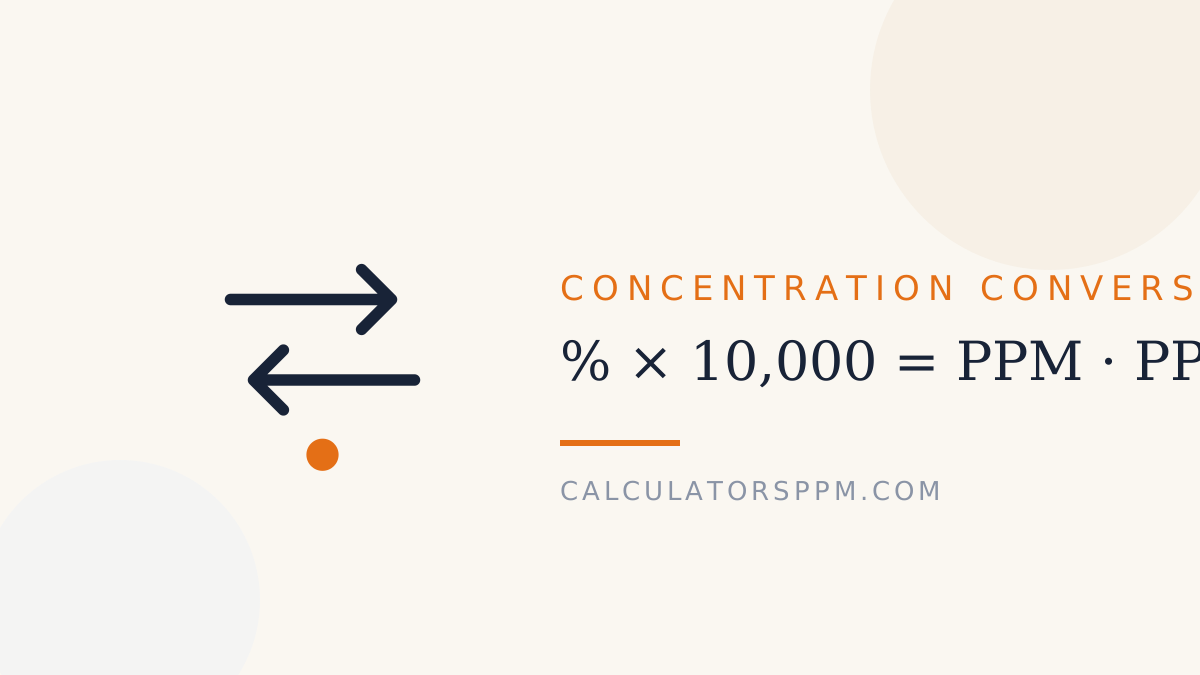
- 1% = 10,000 PPM
- 1 PPM = 0.0001%
- 1 PPM = 1,000 PPB
- 1 PPB = 0.001 PPM
These are scale conversions. They do not require density because both sides represent the same underlying ratio on different numerical scales.
Where PPM is used
PPM appears in water-quality reports, environmental measurements, chemical formulations, manufacturing specifications, laboratory results, soil and solid-matrix measurements, and gas concentration reporting. The meaning changes with the measurement basis and application.
In a laboratory report, for example, “10 PPM” is not enough information by itself if the report needs to be interpreted precisely. The analyte, sample matrix, basis, method, and units should be clear. In a gas application, converting PPM to a mass concentration such as µg/m³ can also require molecular weight, temperature, and pressure.
When PPM can be misleading
The biggest mistakes happen when a PPM number is moved from one context to another without checking its basis. Do not automatically treat PPM as mg/L, do not use solvent mass when the formula requires total mixture mass, and do not compare two PPM values without checking whether they were reported on the same basis.
A concentration number also does not tell you whether a substance is safe, acceptable, or within a legal limit. Those questions depend on the substance, intended use, applicable standard, and measurement method.
Quick PPM examples
| PPM | Percent | PPB |
|---|---|---|
| 1 | 0.0001% | 1,000 |
| 10 | 0.001% | 10,000 |
| 100 | 0.01% | 100,000 |
| 1,000 | 0.1% | 1,000,000 |
What to check before using a PPM value
- Identify the substance being measured.
- Identify the reference quantity: mass, volume, moles, or another defined basis.
- Keep numerator and denominator units compatible.
- Check whether density, molecular weight, temperature, or pressure is needed for a conversion.
- Keep the original units and assumptions with the final result.
For a direct mass-ratio calculation, use the PPM Calculator. If your starting value is already expressed in mg/L, use mg/L to PPM. For the reverse conversion, see PPM to mg/L.
Related PPM topics
Once the basic meaning is clear, the next useful steps are learning how to calculate PPM, comparing PPM with percent, and understanding PPM versus molarity. These relationships use different assumptions, so each should be handled on its own terms.
Frequently asked questions
What does PPM stand for?
PPM stands for Parts Per Million. It describes a small amount of a substance relative to one million parts of a reference mixture.
What does 1 PPM mean?
One PPM means one part of a substance for every one million parts of the reference mixture on the stated measurement basis.
Is PPM a unit of mass?
PPM is a ratio scale rather than a standalone mass unit. It can describe mass-based, volume-based, or other defined concentration ratios.
Is 1 PPM equal to 1 mg/L?
Not universally. For dilute water, 1 PPM is commonly approximated as 1 mg/L because water density is close to 1 kg/L.
How many PPM are in 1 percent?
One percent equals 10,000 PPM because 1% is one part per hundred and PPM is one part per million.
What is the basic PPM formula?
For a mass-based mixture, PPM = (solute mass ÷ total mixture mass) × 1,000,000.
Does density affect PPM?
Density matters when converting between mass-per-volume and mass-based concentration. Direct PPM-to-percent conversion does not require density.
What is the difference between PPM and PPB?
PPM means parts per million, while PPB means parts per billion. One PPM equals 1,000 PPB on the same basis.
When should I use a PPM calculator?
Use a PPM calculator when you need to calculate a trace concentration, check unit conversions, or verify a result using a transparent formula.
Can PPM be used for gases?
Yes, but gas PPM normally represents a volume or mole fraction. Converting gas PPM to mass concentration requires factors such as molecular weight, pressure, and temperature.
What does 1 PPM mean?
On the stated concentration basis, 1 PPM means one part in one million parts of the reference mixture.
Is 1 PPM always 1 mg/L?
No. That is a useful approximation for dilute water-like liquids, not a universal identity.
How is PPM related to percent?
On the same basis, 1 PPM equals 0.0001%, and 1% equals 10,000 PPM.
Use a PPM calculator
Apply the method from this guide with a dedicated calculator.
PPM Calculator
Calculate Parts Per Million from solute mass and total solution mass.
Open →CalculatorPPM to mg/L
Convert Parts Per Million (PPM) to milligrams per liter (mg/L).
Open →Calculatormg/L to PPM
Convert milligrams per liter (mg/L) to PPM considering liquid density.
Open →CalculatorPPM to Percent
Convert concentration from PPM to weight percentage (%).
Open →CalculatorPercent to PPM
Convert percentage concentration (%) to Parts Per Million (PPM).
Open →