
Military PPM vs Scientific PPM: Two Different Meanings
Understand why “PPM” can mean Personally Procured Move in military relocation or Parts Per Million in science, and how to identify the intended meaning.
Read guideClear, practical explanations for PPM calculations, conversions, dilution, chemistry, and concentration questions.
Step-by-step articles with formulas, examples, and links to the right calculator.
Understand why “PPM” can mean Personally Procured Move in military relocation or Parts Per Million in science, and how to identify the intended meaning.
Read guide
Understand why PPM alone does not determine pH and how concentration, molecular weight, acid-base strength, and dissociation affect pH estimates.
Read guide
Learn how serial dilution works, calculate concentration at each stage, track dilution factors, and understand why errors can compound.
Read guide
Learn how chemical concentration depends on the measurement basis and how to choose between PPM, percent, mass/volume, and volume/volume calculations.
Read guide
Learn how to prepare a target PPM solution, convert final volume and density into solution mass, and account for units and assumptions.
Read guide
Convert molarity to PPM using molecular weight and solution density, and understand when water-density shortcuts are acceptable.
Read guide
Learn how to convert mass-based PPM to molarity using molecular weight and solution density, with examples and assumptions.
Read guide
Convert gas mass concentration in µg/m³ to PPM using molecular weight, temperature, and absolute pressure.
Read guide
Learn how gas-phase PPM converts to µg/m³ using molecular weight, temperature, and pressure, with examples and unit checks.
Read guide
Convert percentage values to PPM with the exact formula, examples, decimal checks, and practical concentration-reporting guidance.
Read guide
Learn how to calculate PPM from grams of solute and total mixture mass, including batch examples, unit conversion, and reverse checks.
Read guide
Learn how to convert a target PPM concentration into grams of solute using total mixture mass, with worked batch examples and unit checks.
Read guide
Learn how to calculate Parts Per Million from solute and total mixture mass, check units, interpret the result, and avoid common calculation errors.
Read guide
A practical guide to using a PPM calculator online for Parts Per Million calculations and choosing the right related conversion tool.
Read guide
Learn how PPM can describe trace additives and contaminants in paints and coatings and how to calculate a target batch amount.
Read guide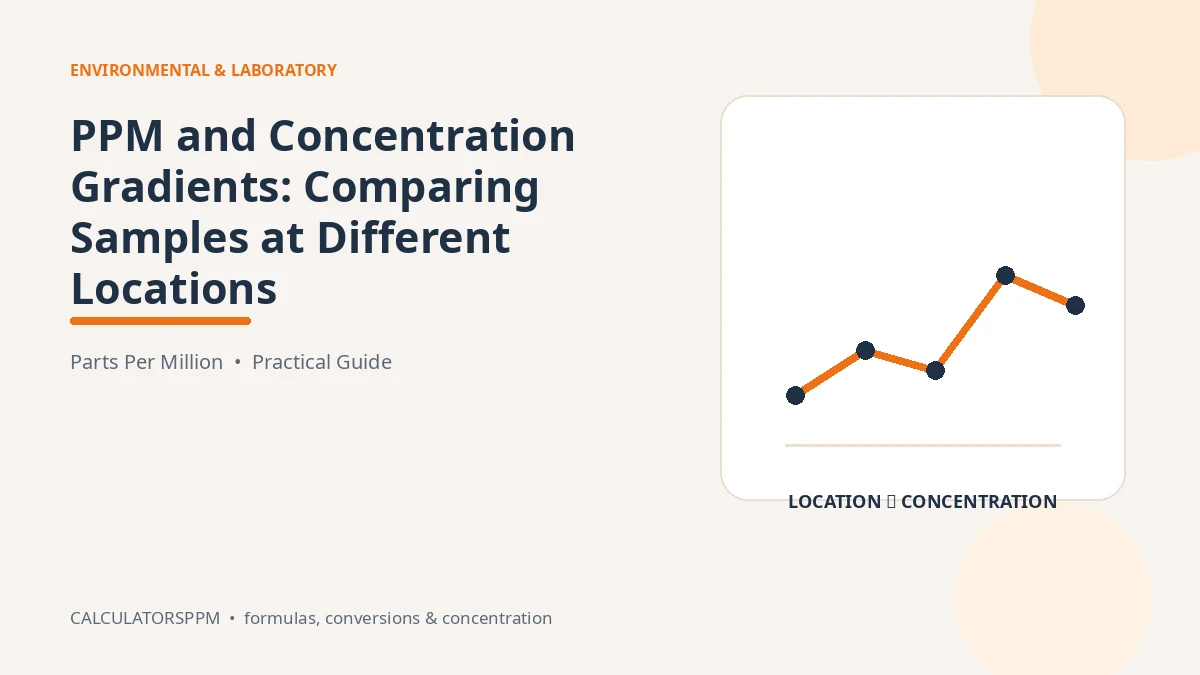
Learn how to compare PPM measurements from different sampling locations without confusing concentration differences with sampling effects.
Read guide
Use a practical checklist to document PPM results with the analyte, basis, units, method, precision, and supporting calculation.
Read guide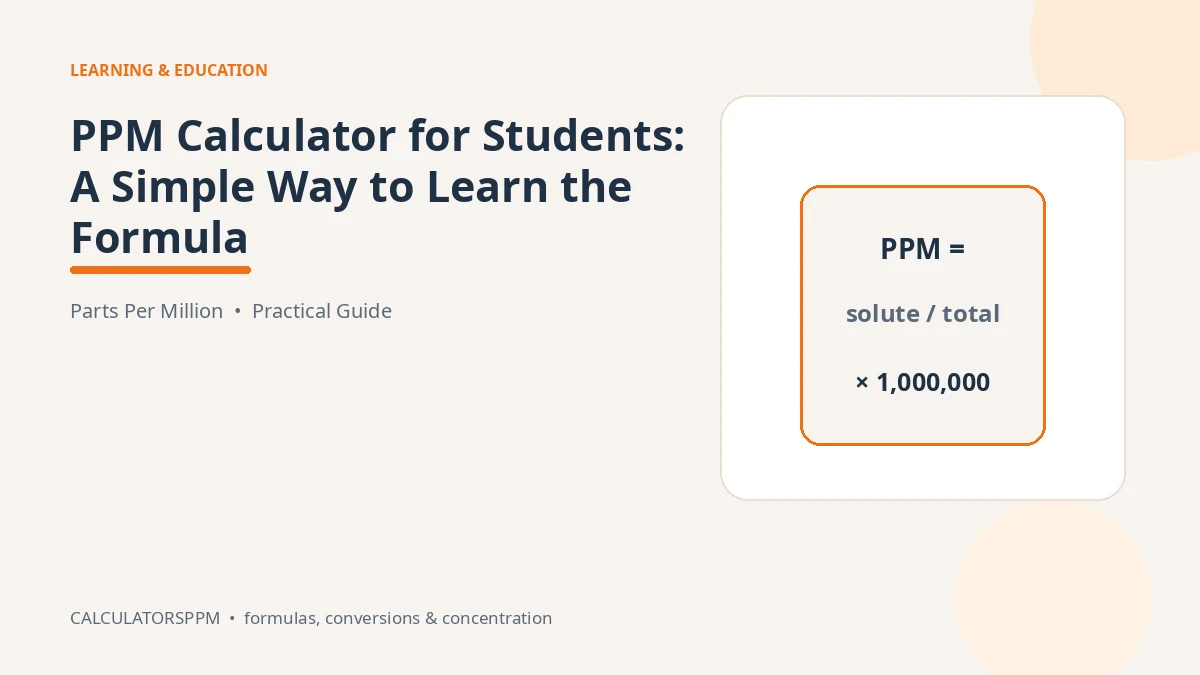
Use PPM examples to understand the concentration formula, unit conversion, and the difference between mass and volume.
Read guide
Follow a batch-mixing PPM calculation from target concentration to required ingredient mass, with a reverse check.
Read guide
Learn how PPM can describe trace contaminants or additives in industrial fluids and why fluid density and test method matter.
Read guide
Compare parts per thousand, PPM, and PPB so you can move between concentration scales without losing track of the ratio.
Read guide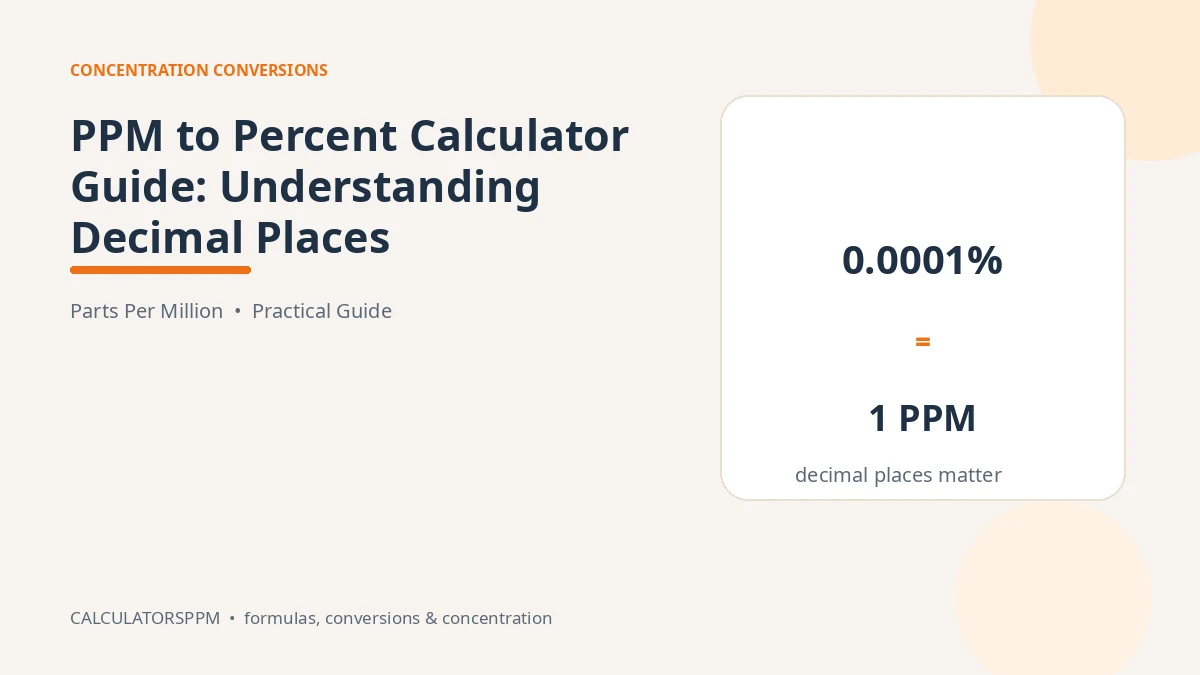
Learn why PPM-to-percent conversions move the decimal four places and how to avoid confusing 0.01% with 0.01 PPM.
Read guide
Learn how to define the concentration basis of a chemical solution before calculating or converting a PPM value.
Read guide
Learn how PPM appears in aquarium water testing and why each parameter needs its own target range and interpretation.
Read guide
Learn how to read PPM values in drinking-water data without confusing a concentration measurement with a safety conclusion.
Read guide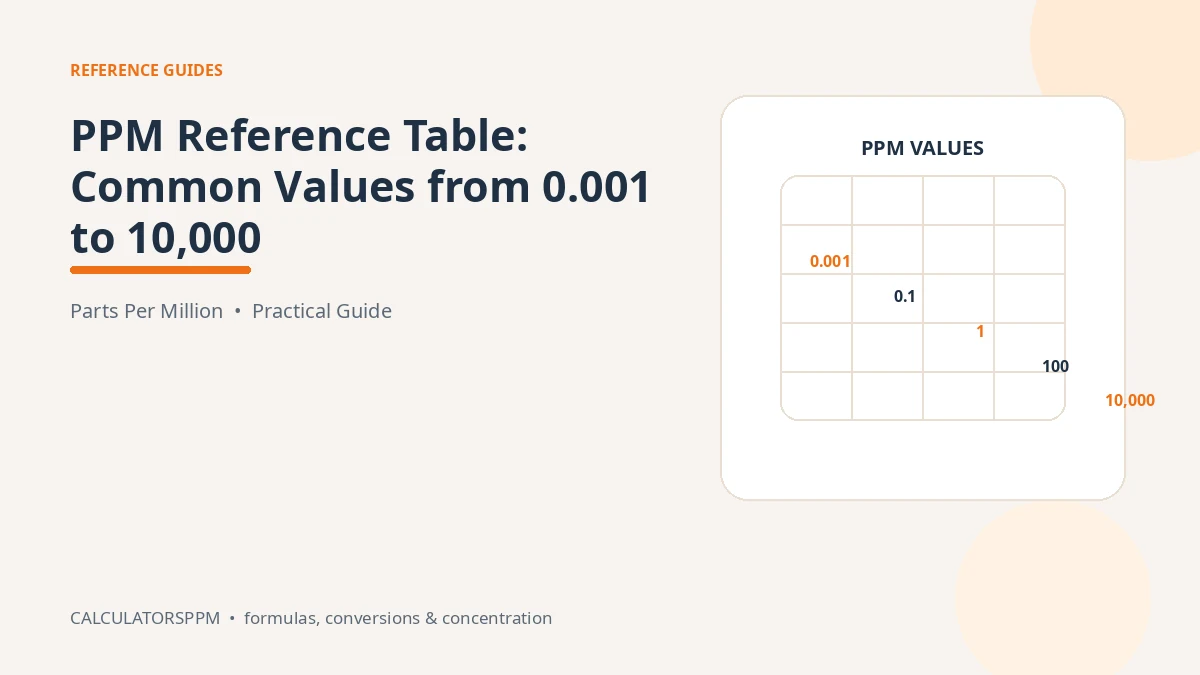
Use a quick PPM reference table to compare PPM, percent, PPB, and mass fraction across common concentration scales.
Read guide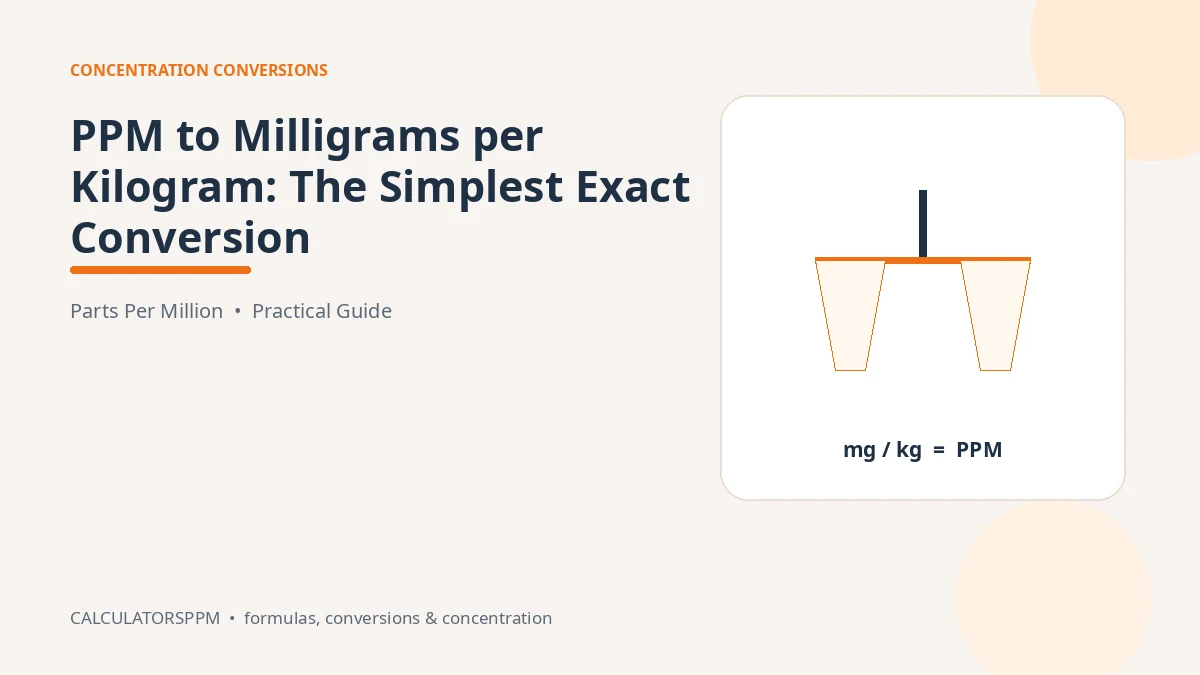
Learn why mass-based PPM and mg/kg are numerically identical and when this shortcut is safe to use.
Read guide
Learn how trace-impurity specifications are expressed in PPM and how to calculate the corresponding mass for a production batch.
Read guide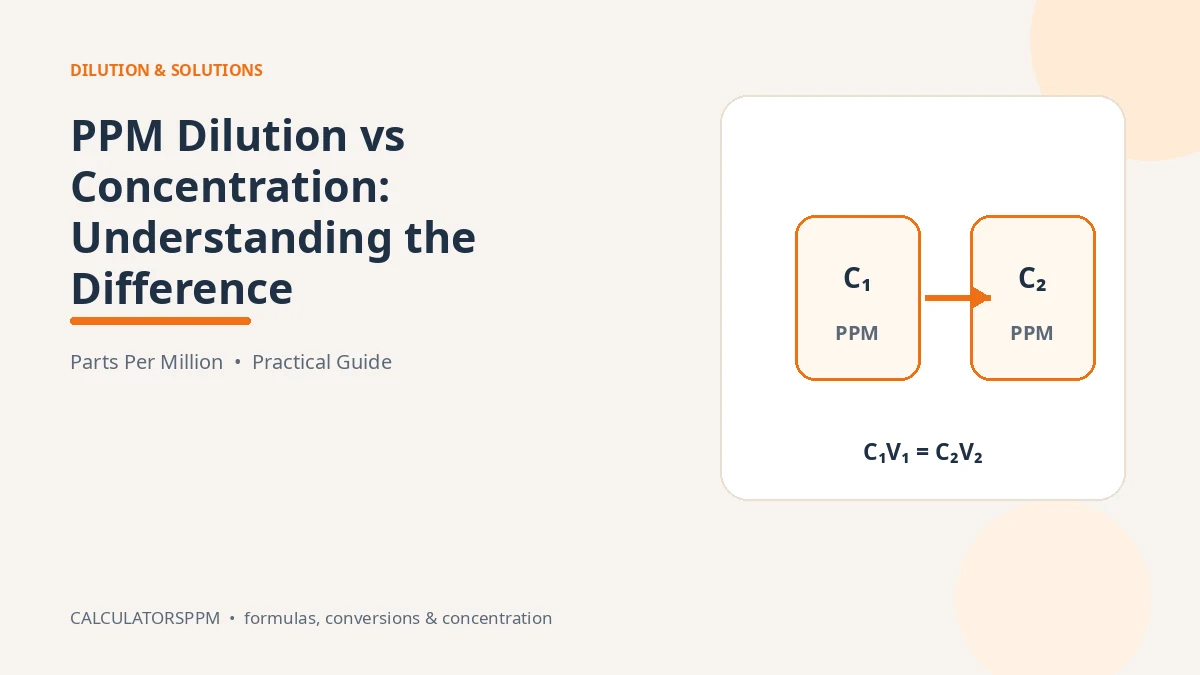
Separate the ideas of concentration and dilution so you can choose the correct PPM equation for a preparation problem.
Read guide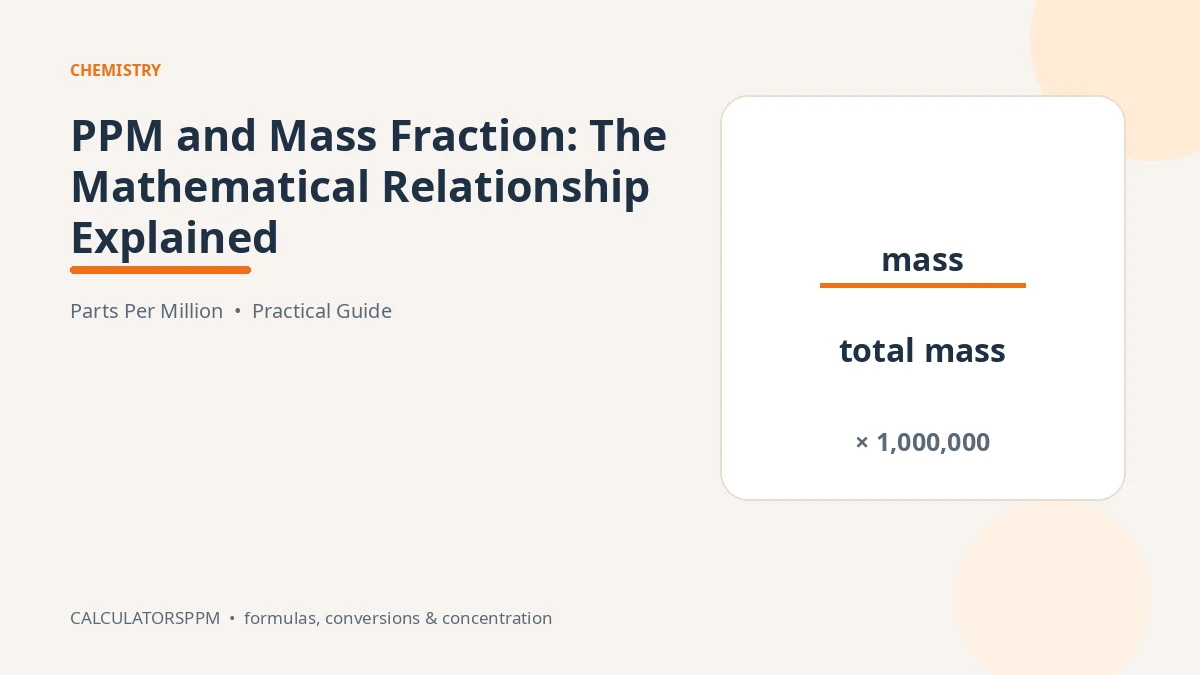
See how PPM relates to mass fraction and why dividing PPM by one million gives the underlying ratio.
Read guide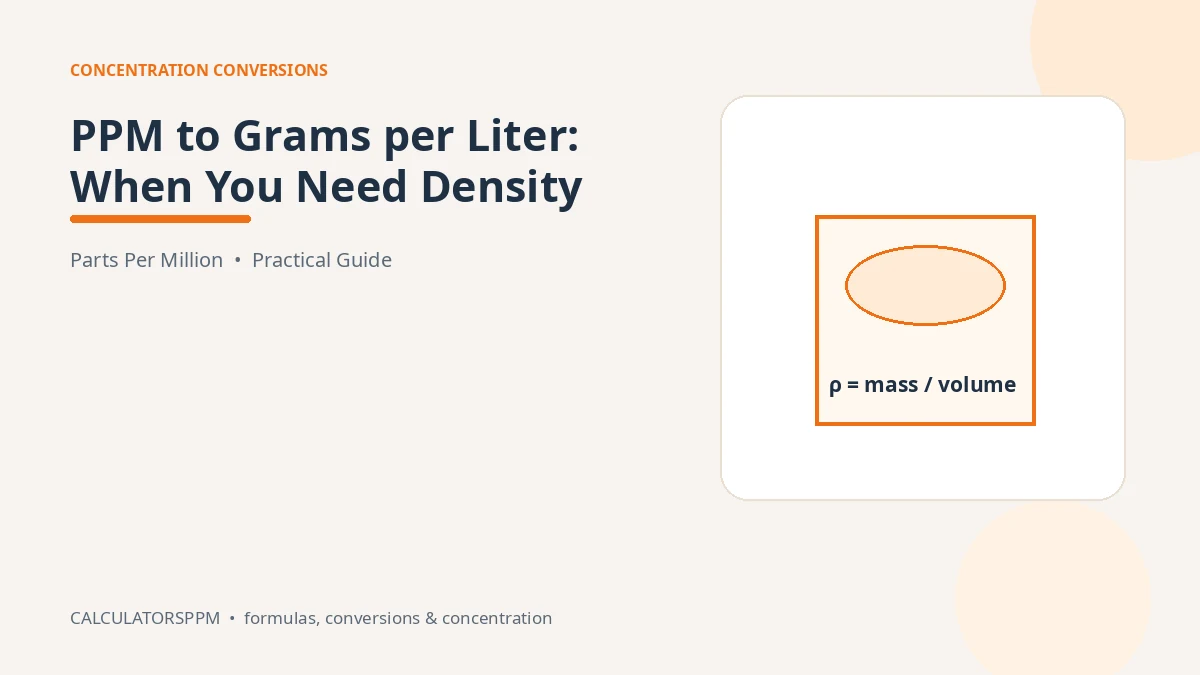
Understand how a mass-based PPM value can be connected to grams per liter when solution density is known.
Read guide
Understand the difference between gas PPM and µg/m³ and why molecular weight, temperature, and pressure are needed for conversion.
Read guide
Learn what to look for when a laboratory report gives a PPM result, including basis, method, detection limits, and reporting precision.
Read guide
See how PPM can be used in manufacturing specifications, defect reporting, material composition, and quality-control calculations.
Read guide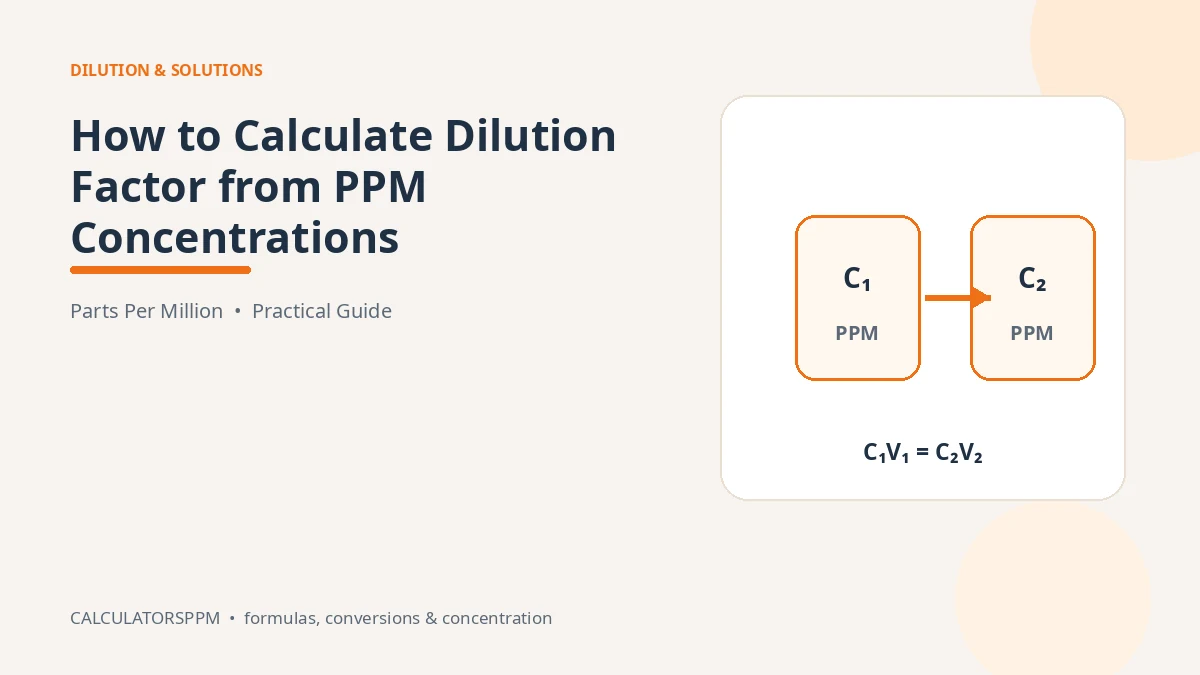
Calculate dilution factor from stock and target PPM, distinguish factor from volume, and use the result to plan one-step or serial dilutions.
Read guide
Understand PPM in water, the common 1 PPM ≈ 1 mg/L shortcut, water-quality reporting, and the limits of interpreting a number without context.
Read guide
Compare PPM and molarity, understand molecular-weight and density requirements, and choose the concentration scale that fits the calculation.
Read guide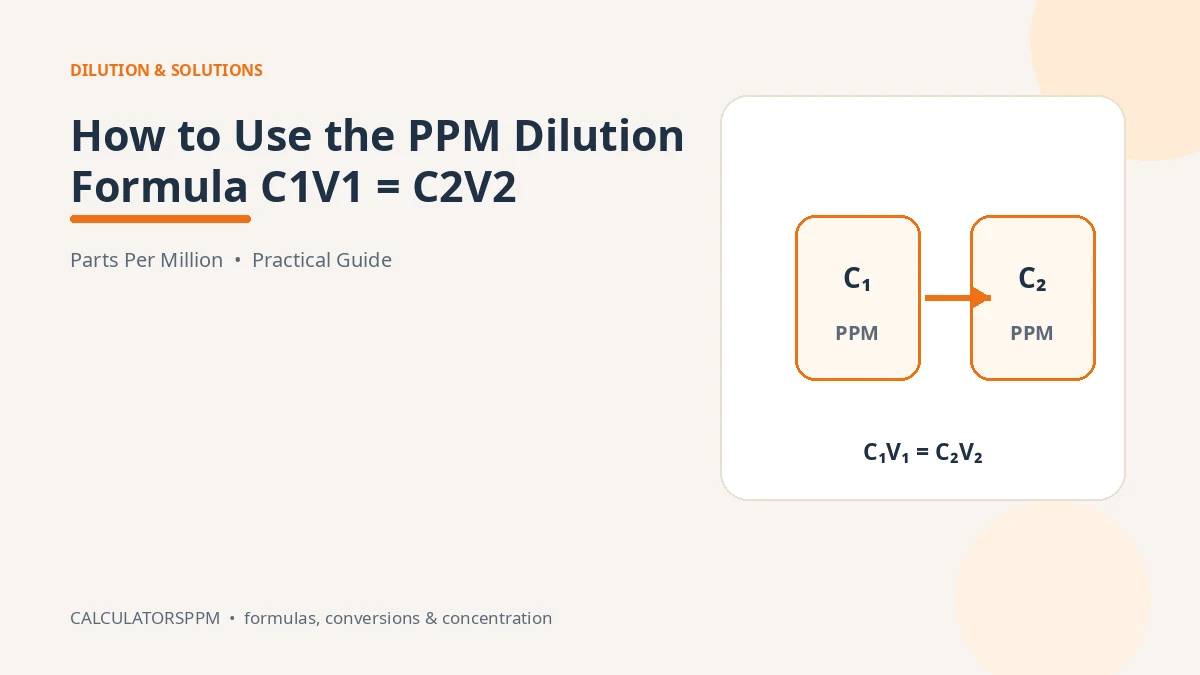
Learn how C1V1 = C2V2 applies to PPM dilution, how to solve for stock volume or final concentration, and how to check dilution calculations.
Read guide
Understand the exact PPM-to-PPB scale factor, worked examples, reporting choices, and common mistakes when handling trace concentrations.
Read guide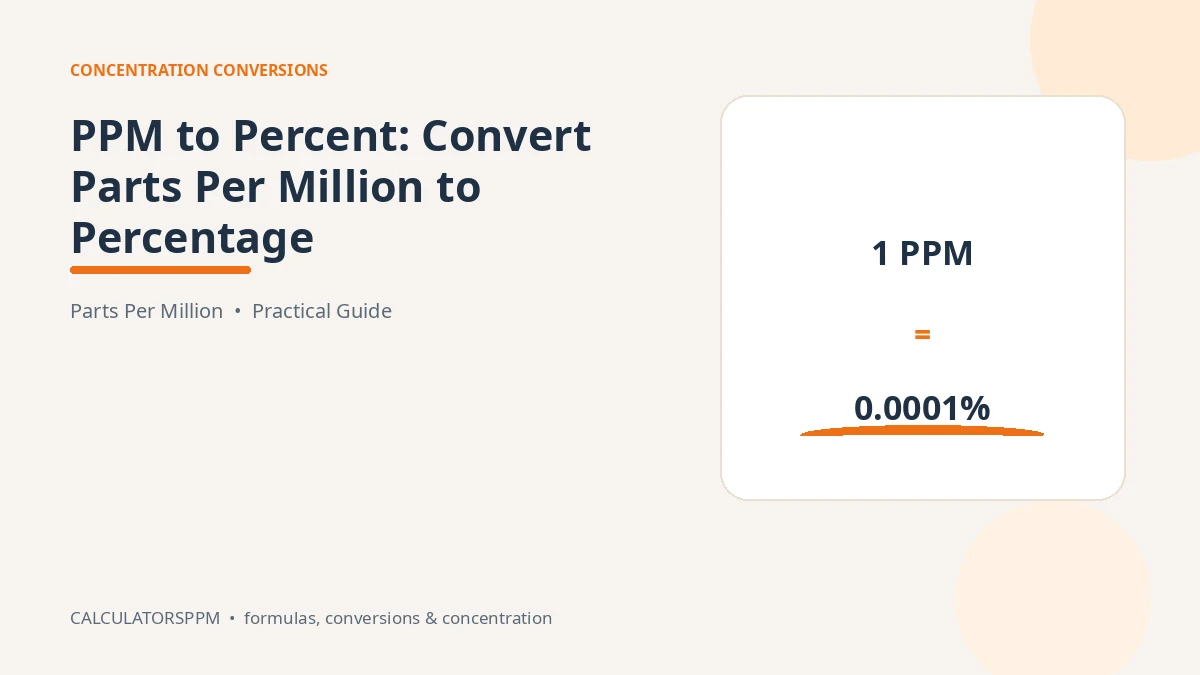
Learn the PPM-to-percent formula, decimal placement, examples, reference values, and how the conversion differs from PPM to mg/L.
Read guide
Convert mg/L to PPM using density, understand the dilute-water shortcut, and avoid treating mass-per-volume and mass-per-mass units as identical.
Read guide
Understand when PPM and mg/L are numerically equivalent, when density matters, and how to convert correctly for different liquids.
Read guide
Learn the standard mass-based PPM formula, how to align units, calculate target concentrations, and check the result.
Read guide
Understand what Parts Per Million means, how the ratio works, and why PPM can represent different concentration bases.
Read guide