
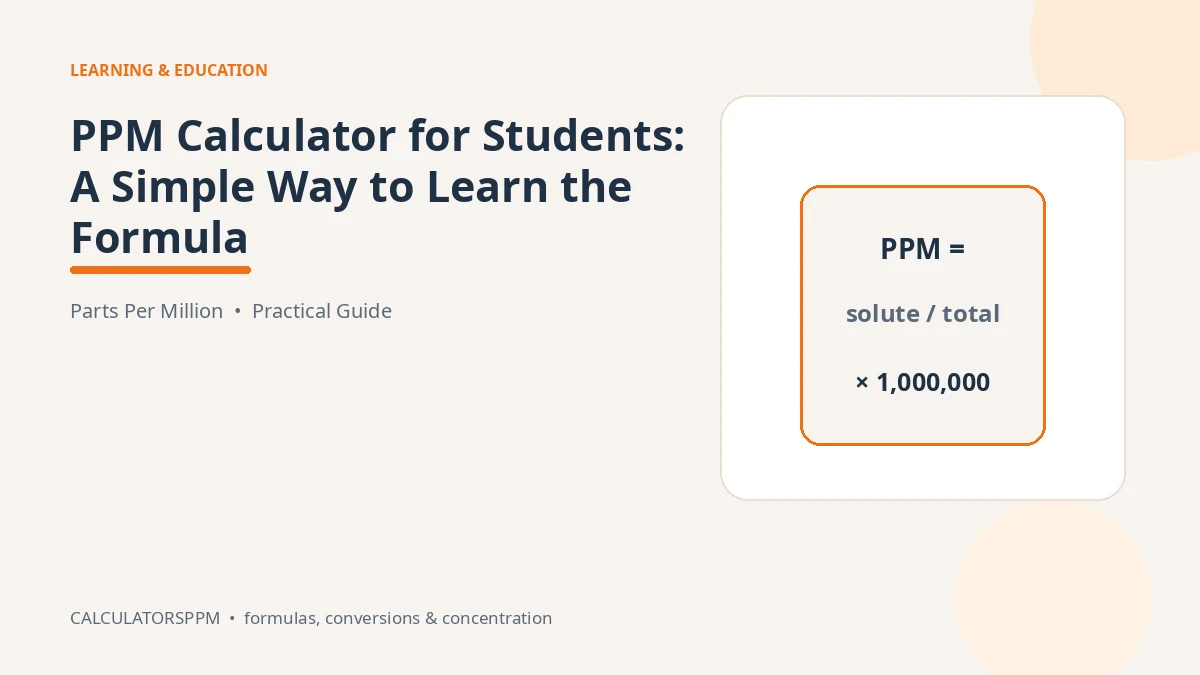
PPM problems are usually ratio problems disguised by unfamiliar units. The easiest way to solve them is to identify the measured substance, the reference amount, and the concentration basis.
Basic formula
Student example
If 0.5 g of solute is present in 50,000 g of mixture:
Three questions to ask
- Are both quantities on the same unit basis?
- Is the denominator the total mixture when using mass fraction?
- Does the formula match the measurement type?
Useful shortcuts
Remember 1 mg/kg = 1 PPM for mass-based concentration, 1% = 10,000 PPM, and 1 PPM = 1,000 PPB.
Why calculators still help
A calculator can reduce arithmetic mistakes, but students should still write the equation and units. Understanding the setup is more important than copying a final number.
Summary
Learn the ratio first, then use the calculator to verify arithmetic. PPM becomes much easier once the concentration basis and units are explicit.
Related calculator: PPM Calculator can be used to verify the arithmetic after you identify the correct concentration basis.
Understanding the context behind a PPM calculator for students
a PPM calculator for students becomes much easier to use when the number is treated as a concentration statement rather than as a standalone value. In a chemistry homework problem or classroom example, the first question should always be what the “parts” refer to and what quantity is being used as the reference. A PPM value is a ratio scaled to one million, but the physical interpretation depends on whether the ratio is based on mass, volume, moles, gas fraction, or another defined measurement basis. Keeping that definition visible prevents a common problem: a mathematically correct conversion being applied to the wrong type of measurement.
For practical work, pay attention to solute, total mixture, unit conversion, formula selection, and reasonableness checks. These details determine which formula is appropriate and whether a direct conversion is valid. If two results use different bases, they may need additional information before they can be compared. This is especially important when moving between mass-based PPM, mg/L, molarity, gas concentration, percentage, and PPB. A calculator can perform arithmetic quickly, but it cannot decide whether the inputs describe the same physical quantity unless the user supplies the correct context.
Worked example and interpretation
Consider this example: 0.5 g of solute in 50,000 g of mixture gives 10 PPM on a mass basis. The arithmetic is only one part of the calculation. The result should also be labeled with its basis and, where relevant, the substance being measured. On a mass basis, PPM can be understood as a scaled mass ratio, so the underlying fraction can be converted back to a decimal or percentage if another reporting format is required. When a result is used in a laboratory, manufacturing, environmental, or educational setting, keeping the original inputs beside the final value makes the calculation easier to review.
A useful habit is to perform a reverse check. If the result is given in PPM, divide the value by 1,000,000 to recover the corresponding mass fraction on a mass/mass basis. You can then compare that fraction with the original quantities. For conversions, perform the reverse conversion when practical. If the two paths do not agree, check unit prefixes, the denominator, density assumptions, molecular weight, or reference conditions before accepting the result.
Choosing the correct PPM basis
The word PPM does not by itself specify the measurement basis. For a solid or bulk material, mass/mass is common. For dilute water solutions, PPM is often used as a practical approximation to mg/L because water density is near 1 kg/L. That shortcut should not automatically be extended to concentrated solutions or other liquids. For gases, PPM commonly describes a volume or mole fraction, and converting it to a mass-per-volume unit requires gas-specific information.
When a result is being compared with a specification, the safest approach is to use the same basis as the specification. Do not silently replace a dry-weight result with a wet-weight result, or a mass/mass concentration with a volume-based value. If a conversion is necessary, record the additional assumptions used. This makes the final number traceable and helps another person reproduce the calculation without having to infer what was intended.
Common calculation and reporting mistakes
- Mixing grams, kilograms, milligrams, liters, or cubic meters without first checking whether the formula expects the same basis.
- Assuming that every PPM result has the same relationship to mg/L regardless of density or measurement type.
- Using a liquid concentration shortcut for an air or gas calculation.
- Rounding an intermediate value too early and carrying the rounded number through later conversions.
- Comparing two PPM results without confirming that they describe the same analyte and measurement basis.
- Reporting a very precise number when the original measurement or analytical method does not support that precision.
One particularly important mistake is entering numbers into a calculator without first identifying the numerator and denominator can produce a polished but incorrect answer. A calculator may return a plausible number even when the selected formula does not match the problem. Always read the units and assumptions before deciding that a result is correct.
A practical workflow for reliable PPM calculations
write the known quantities, convert units, apply the formula, and explain what the final PPM means in words. Start by writing down the known quantity, the reference quantity, and the target unit. Next, convert compatible quantities to a common basis. Then select the formula or dedicated conversion tool that matches the measurement. After calculating, check the order of magnitude and perform a reverse calculation if possible. Finally, record the result with enough information that another reader can understand exactly what the number represents.
This workflow is useful even when the calculation is simple. It separates the scientific definition from the arithmetic and reduces the chance of copying a value into the wrong field. It also makes it easier to audit repeated calculations in a spreadsheet, laboratory notebook, production record, or technical report.
When an online calculator helps
An online calculator is useful for reducing arithmetic errors and quickly testing different input values. The best tool for a problem depends on the input you already have. A basic PPM calculator is appropriate when the required quantities and mass-based formula are known. A dedicated converter is preferable when the input is mg/L, PPB, molarity, percentage, or a gas concentration. Using the matching tool avoids forcing unrelated concentration systems into one formula.
For repeated work, use the calculator as a verification step rather than as a substitute for defining the measurement. Keep a record of the inputs, selected units, assumptions, and final result. If the result will affect a regulated, safety-critical, laboratory, production, or environmental decision, verify it against the applicable method, specification, or professional guidance as well.
How to document a PPM result
A clear PPM result should identify the measured substance whenever that matters, state the concentration basis, show the value and unit, and preserve any important assumptions. For a conversion, include the source value and the converted value so the direction of the calculation is obvious. If temperature, pressure, density, molecular weight, or dry-weight conditions were used, keep those details with the result.
Good documentation is not just a formatting preference. It protects the meaning of the number when the result is copied into another report or compared with a later measurement. Two values that both say “10 PPM” may represent very different quantities if their analytes or bases differ. A short explanatory label can prevent that ambiguity.
Key takeaway
PPM is a simple million-part scale, but accurate use depends on the concentration basis and the units behind the number. Define the numerator and denominator, choose the matching formula, avoid unsupported shortcuts, and keep the assumptions visible. Once those checks are in place, PPM calculations and conversions become easier to reproduce, compare, and explain.
Frequently asked questions
What is the basic PPM formula?
PPM = solute mass ÷ total mixture mass × 1,000,000 for a mass-based calculation.
What shortcut should students remember?
1 mg/kg = 1 PPM on a mass basis.
Should units be converted first?
Yes. Compatible units prevent large factor errors.